
More radio shows
A recap on the last few months Source of Uncertainty shows

The great thing about trying to engage with less insubstantial social media based things is, because things are so app-dominated, I end up just tuning out a lot of other things, the need to document and advertise everything falls away quite easily. I started using Substack as I missed reading about the stuff I’m interested in and was tired of seeing stuff pushed out as images that look like thinly veiled pleas for attention in a time when everyone is extremely distracted, but as a result, I’m also just trying to enjoy things in a less internet-mediated way anyway. I am back to my preferred method of listening to the music I buy: giving it at least five listens before putting it on a shelf it might not move from for a while. After five goes, I either want to keep listening or need a break, but I have reasonable confidence that I’ve gotten the gist. It’s simple enough, but very satisfying to get back to becoming properly familiar with stuff. And as I’m trying, desperately, pathetically, to look at my phone less, I’m also listening to this stuff while reading, more often than not. I’ve been absolutely eating the books lately, beats seeing some stranger effectively abuse their pet into becoming an animal avatar for some form or other of influencing while scrolling endlessly in no discernable direction other than away from my dignity.
The last show I posted about here was episode 69, so I’ll try run through the five more shows that followed that.
Sources of Uncertainty Episode 70
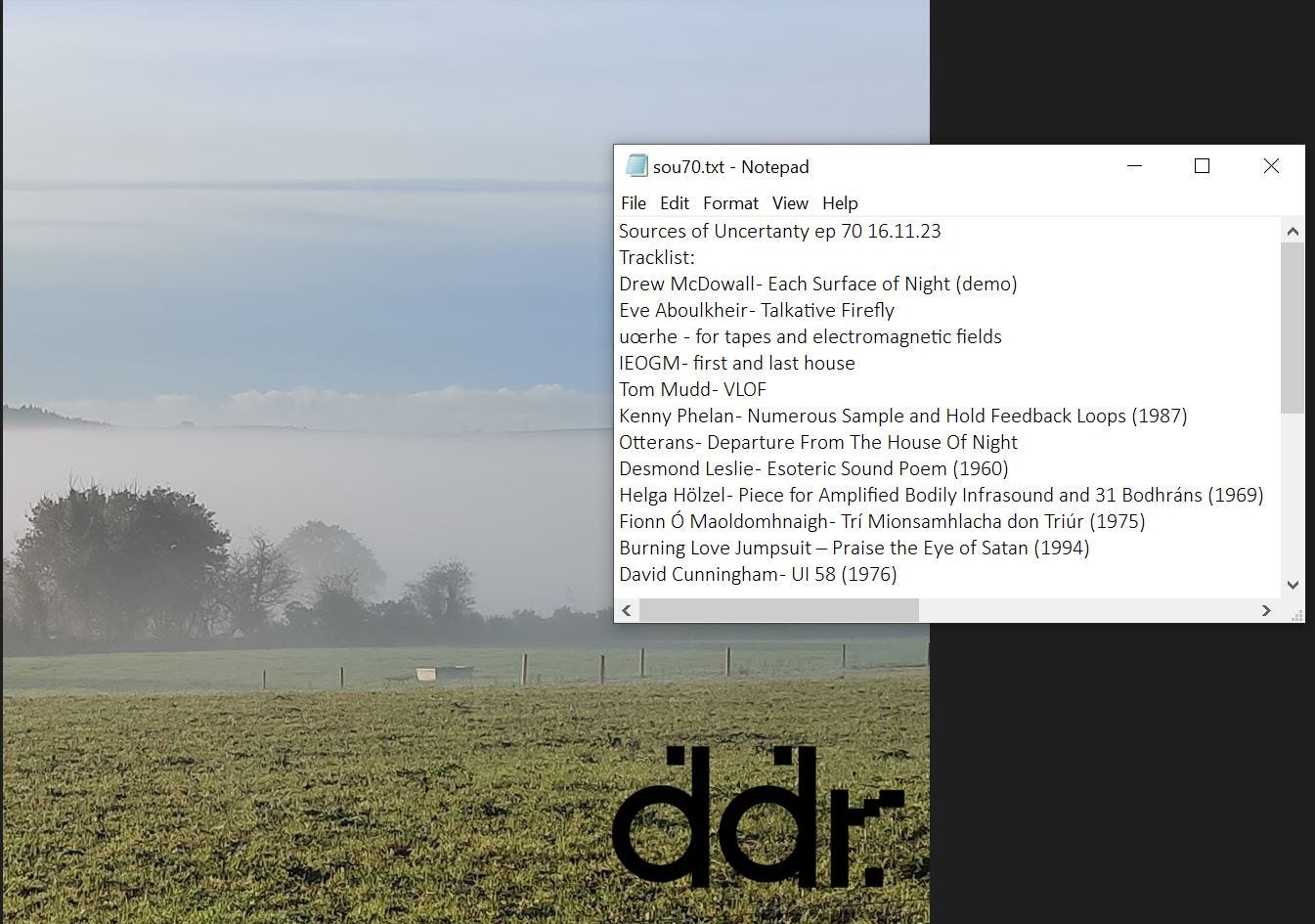
https://www.mixcloud.com/DublinDigitalRadio/sources-of-uncertainty-ep-70-161123/
This show starts off with Drew McDowall with a track from the big and massively enjoyable 6 disc box set Lamina. Knowing McDowall as having played with Coil, he’s always had my implicit respect, and yet I never gave myself the time to listen to him extensively. This might be one of few cases where a box set was the perfect, achievable, solution to a problem of wanting to get to know someone’s music properly. I bought myself a birthday present of the set and it was a significant portion of my winter soundtrack. Cold, shifting synthesiser texture characterises most of McDowall’s music, there’s a distinctive, probably modular based, pulse and drift to the music, and crucially for me, it feels from a time where genre definitions and signifiers were low on the list of priority.
Eve Aboulkheir has a complimentary style to McDowall, that same textural shifting feeling, and the sense that a pulse exists not to tie the sound to a rhythmic grid, but to add to the shape and swing of the music. I heard Hypnagogic Walks from browsing the KRAAK bandcamp, which usually doesn’t disappoint in pointing me to music sympathetic to my sensibilities.
uœrhe has been on my radar for a while, and Paul sometimes appears as a dog with horns was the first thing of theirs that I got properly into. It sits nicely in between incidental sound and more ‘deliberate’ sound. The blurb mentions ‘The humming of electrical appliances and test equipment blends with melancholic voices of solitary displays and empty tapes.’ which tells me to expect this kind of blend. But nothing feels random or thrown together here. There’s a distinctive atmosphere and an always enjoyable sense of the intentional and incidental warping. Great stuff.
Dolphins in Cornwall from IEOGM keeps this shifting, warping, feeling going. Static tones sit under wheezing waves of sound and a light percussive sound. It all feels fluid but never out of control.
Tom Mudd provides a move away from the shifting and textural to something concrete and explicit, but not lacking in it’s own oddness. Based on programmable guitar sounds, Guitar Cultures is full of familiar sounds in impossible sounding arrangements, taking the ubiquitous sound of a guitar and stretching it’s possibilities. The album often feels playful but never just like pure novelty, the uncanny sense becomes essential to the feel of it as a whole, and it’s a reminder that experimental music can still actually go and experiment.
There are a few tracks in this show from Miúin’s Kilkenny Electroacoustic Research Laboratory Anthology Vol. 2 - Raidió na hEorpa from Kenny Phelan, Helga Hölzel, and Peter Morton/Fionn Ó Maoldomhnaigh. This compilation, put together by the great Neil Quigley comes with some detailed notes. They might make you doubt the provenance of the music on the compilation, or they might just make you envious of the time period you were born in. Either way the quality of the music, for it’s experimentation, structure and presentation, speaks for itself, so I won’t belabour the point but I’ll just urge you to dive in yourself.
Before more compilation tracks, there’s one from Otterans, the solo guise of man of many projects, Jamie Grimes, someone I’ve seen wear many hats, usually of the heavy guitar music variety, but here he is solo, making music heavy on atmosphere, with this particular track borrowing from a genre I really enjoy, ‘music for a film that doesn’t exist’. Here showing Grimes’ penchant for horror. Great album, and who need films when you can just imagine them in your head. It’s simply more efficient.
The last tracks on this show are from Nyahh Records’ Under the Island: Experimental Music in Ireland 1960 - 1994. An excellent compilation which provides a picture of experimentation with music from a time before the internet, before terms like ‘experimental’ could be homogonised and when genuine trying new things out, not just with sound but with the formalities of music could happen. I picked tracks from Desmond Leslie, Burning Love Jumpsuit and David Cunningham, but I’d encourage you to check the entire thing out.
Sources of Uncertainty Episode 71
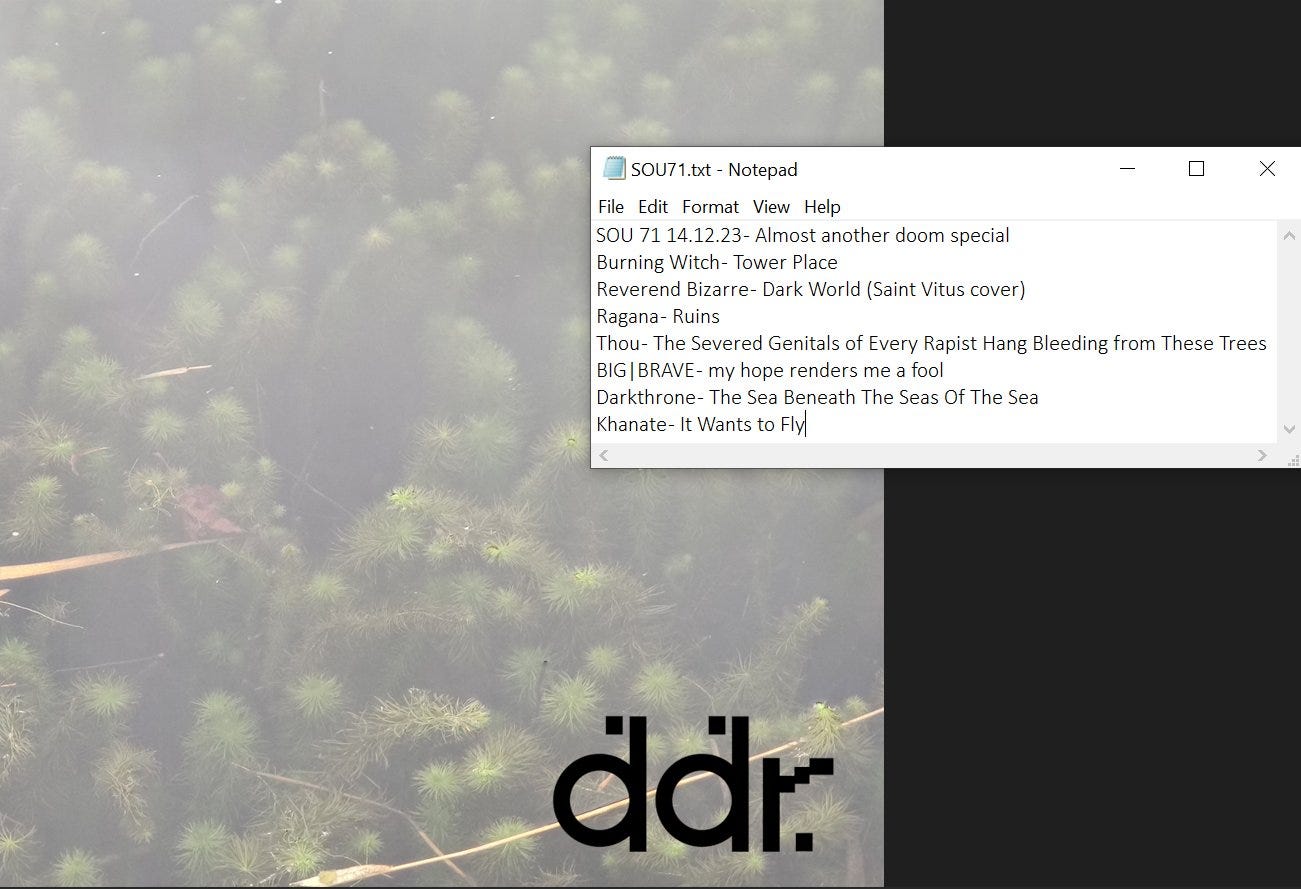
In December 2021 I made a Doom Special for the radio show. Something about the middle of winter made it seem appropriate. I really enjoyed making it, it was very nostalgia focused, and was a nice excuse to go listen to a lot of doom, new and old.
I wanted to make it an annual thing but for some reason I skipped a year, so this is the second, and as the title suggests, it’s not strict on doom, but the focus is on atmosphere, a spirit of doom, if you will.
I started with Burning Witch, tracks from Crippled Lucifer regularly pop into my head, and one key thing always sticks with me when that happens: the vocals are brilliant. Inventive, unsettling, genuinely hard to listen to in places.
In keeping with the older stuff theme, I went for a twofer with Reverend Bizarre covering Saint Vitus. Reverend Bizarre will always be a favourite for me. I didn’t get to see them when they played in Dublin close to 20 years ago, but the reports from that gig from my brothers was the start of a love for them that’s never dwindled. Some albums remind me distinctly of being in my brother’s car, possibly driving to a beach. Maybe not the doomiest of settings, but they fit most occasions. I don’t know all the lyrics, but I reckon I know 90% of the ‘oooh yeah’s and other miscellaneous shouts. Everything in their music is perfect to me.
Ragana are another band with strong Brother’s Car connotations. From their first demo, there was something I found very gripping, the song structures sometimes feel like a deliberate affront to more macho metal tropes, but the sense of forboding and capacity to build depth and intensity is always there. I think Desolations Flower came along at the perfect time also.
The Thou track, conveniently found on the Oakland compilation, is another classic from me. Top track title and the perfect heaviness behind it to back up the sentiment. A band that keep evolving however they see fit, and never stop being inspiring.
BIG|BRAVE are a bit of a newer one for me, I was definitely late to them, but did get there just in time to ask as politely as I could manage for Siorai Geimhreadh to support them when they played Cork in September. The guitar tone is so nice and thick, and the balance of weight and tension is never not exciting. Listening to Nature Morte now has the added bonus of bringing me back to the incredibly sweaty gig they played here.
I think including Darkthrone is what made me include the genre-caveat for this show. While they are experts at subverting and manipulating genre expectations, I can’t run the risk of being some kind of false who thinks they’re a doom band. Petty insecurities aside, Astral Fortress was a timely reminder that no one does it better. Fenriz’ pan-historical metal knowledge oozes out of the music, we’re so lucky to have Darkthrone around to upend any pointless misconceptions or vein commodification of underground metal.
The show ends with a new track from Khanate, completing an accidental O’Malley bookend. Tension and weight were mentioned earlier, but the return of Khanate emphasises how special they are, so fully realised and harrowing. I really love that To Be Cruel is as focused and vicious as their older stuff. Brilliant to be able to pick up and continue something so singular as the music they make.
Sources of Uncertainty episode 72
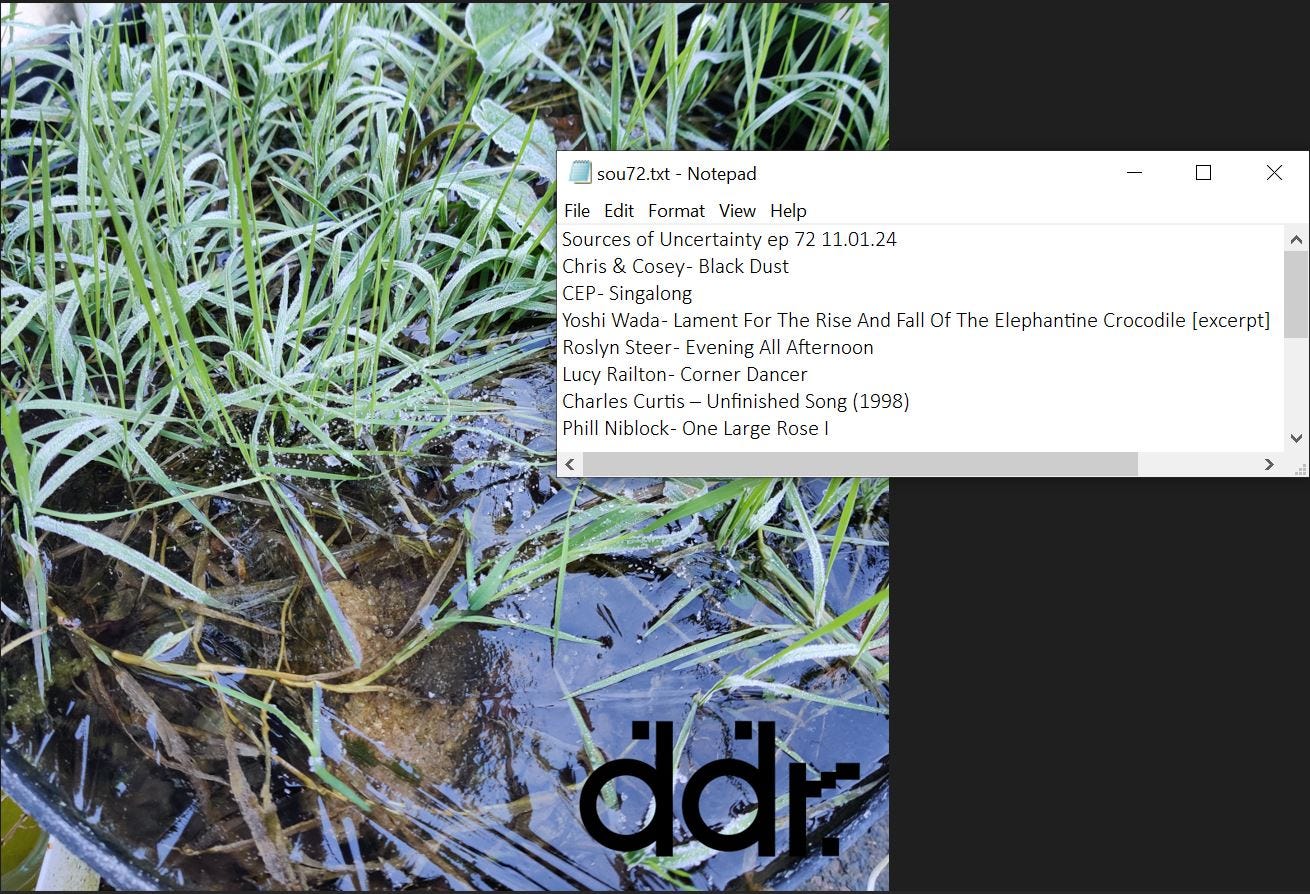
https://www.mixcloud.com/DublinDigitalRadio/sources-of-uncertainty-ep-72-110124/
Into 2024 and continuing to document what I spent my winter listening to.
This Chris and Cosey track is from the great Feral Vapours of the Silver Ether album, which is relatively recently reissued. I love this album, how different it is from the more heavily beat-centered music they’re known for. It’s nice to see it back available after a long time of me having to access it by mildly nefarious means. I actually spent more of my winter listening to Heartbeat, but sure say nothing.
I’d only read about Caroline Polacheck’s CEP album very recently, and while nothing surprises me about her, that didn’t stop me from telling everyone who would listen to me about Drawing the Target Around the Arrow. Reading about it in an article about CP, I was curious what someone with such sharp sensibilities for dense pop music would make outside of that format. The album is full of subtlety and simplicity, and doesn’t feel full of tropes or popular experimental music idioms.
A lot of my January was spent listening to Yoshi Wada’s Lament for the Rise and Fall of the Elephantine Crocodile. An album that’s admittedly difficult to choose a single section of for a mix like this, so hopefully I did it justice. This is longform and focused on the acoustic properties of the space it was recorded in, a classic for a reason and I’m still finding new things in it on every listen.
Roslyn Steer has a knack for quietly releasing excellent music. You never know what you’re going to get with her, and this self released (and now available as a tape from Fort Evil Fruit) album pushes her music in yet another direction. Hinging around voice and varied instrumentation, there’s a loose, always atmosphere heavy construction on Thirteen Ways of Looking at a Blackbird. Calling things ‘singular’ is probably an easy trope for someone of my disposition, but one of the great things about Ros’ is that her music is so full of varied reference points, you’ll never pin it down to anything simple.
Speaking of how simple it is to call things ‘singular’ sometimes, a favourite hobby of mine is enthusing about Lucy Railton’s music. Which I’ve even done before on this blog. Cello and electronics move around each other deftly and never fail to be enveloping and impressively tropeless. If I were in the habit of making lists arranged in order of merit, there’d be a few lists Corner Dancer could be near the top of.
I’ve spoken previously about how swiftly I got into Charles Curtis so lucky me when my better half gave me a gift of his Performances & Recordings 1998-2018 album. I often throw in words like ‘masterful’ for emphasis, but there are few players with a depth of skill and knowledge with their instrument as Curtis. So much so that it would be easy wonder why he’s not talked about more. It’s the cello like, everyone loves it.
A sad one to finish this show, in memory of the brilliant Phill Niblock. An endless inspiration and one of the most generous people towards the world of experimental music and film. This track is from Touch Strings. Given the high volume his music is intended to be played at, it felt almost inappropriate to include him here, but I also couldn’t not. A true legend.
I’d highly recommend these interviews with him:

https://www.frieze.com/article/sense-time
Sources of Uncertainty episode 73
https://www.mixcloud.com/DublinDigitalRadio/sources-of-uncertainty-ep-73-8224/
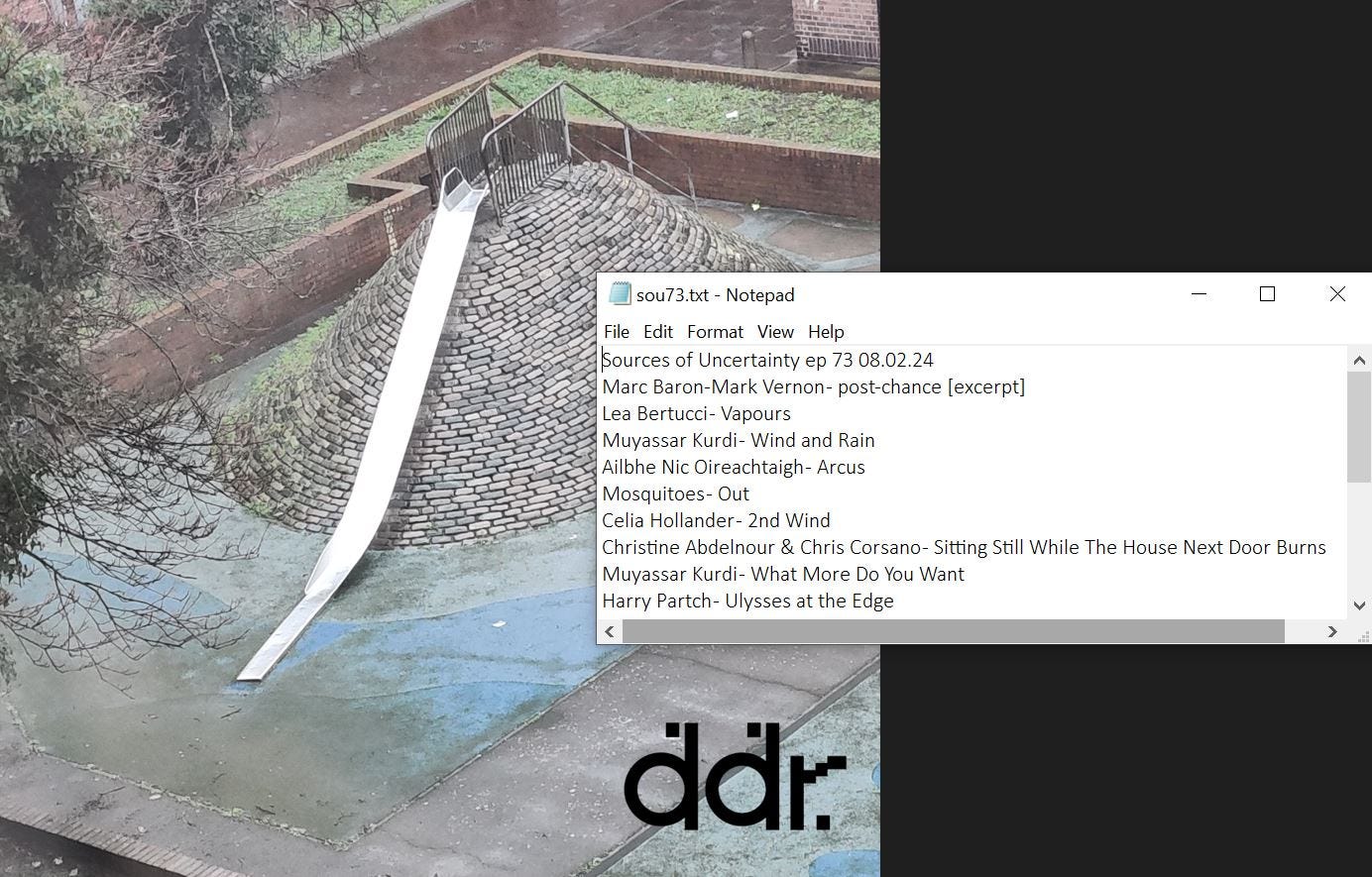
I took this picture while on that little UK tour in February, it’s the view outside my friend Orlaith’s window, and it’s got so much going on.
A few years ago I spent maybe half a year listening to Marc Baron’s Carnets. There’s something brilliantly controlled and engrossing in his music. On post-chance, with Mark Vernon, this same control and subtlety is used. Sounds move around, appear and disappear sometimes suddenly, but everything feels like a well executed playing with tension. Sound wise, there are some slightly uncomfortable high frequncies, and the occasional bit of noise, but it all works to move and engross.
It’s nice seeing Lea Bertucci’s name get a lot of recognition over the last few years. On Of Shadow and Substance. There’s lots of texture and tension, unlike the sparseness of Baron and Vernon, Bertucci creates tension through sustain, strings whirling slowly let the piece move at it’s own steady pace, never just ambient or allowing itself fade into the background, what I love about Lea Bertucci’s music is how quietly it holds your attention.
I got to know Muyassar Kurdi’s music when I saw performances of her graphic scores at a Palestinian Solidarity event in Dublin. Visually and sonically, those pieces are striking, and given the current ultra violent continuation of the long standing subjugation of Palestinian people, it’s hard not feel an intense sense of mourning and despair when listening. But there’s also a crucial self-determination. Art like this is the continuation of struggle, it’s inherently defiant and allows voices to reach us that are often cut off. On Birth of a Thousand Moons there’s a similar sense of mourning and alienation, but with more of a focus on electronics and rhythm, this feels framed differently. I’m wary of overstating any points or othering by projecting onto the music, but this album, and Kurdi’s scored music is excellent and well worth more attention.
It’s always a good time when Ailbhe Nic Oireachtaigh releases new music. While she’s always busy with solo work and collaborations, her name has steadily been appearing in more and more places. Ailbhe is the definition of a hard working musician, and the intense practice and studiousness she puts into her instrument is clearly audible in her playing. Live at Sonic Arts feels like an evolution from previous solo recordings, leaning more into saturated viola tone in places. The dexterity of Ailbhe’s playing always has some new element to be heard on each listen.
Mosquitoes are a relatively new band but their name seems to be appearing everywhere. They take the ‘pulling apart rock music’ form and do it well. Drip Water Hollow Out Stone good and noisey, tastefully done and enjoyably odd.
I’d first heard Celia Hollander’s music under the name $3.33 and here under her own name is more of her dense piano playing. Unlike other stuff I’d heard from her, the tracks on 2nd Draft are impressively short, packing in a huge amount into each in an average track length of about three minutes. This does something to make the album feel like a series of images as opposed to one longform drift.
Christine Abdelnour & Chris Corsano’s album Quand Fond La Neige, Où Va Le Blanc ? is maybe what you’d expect from either musician. That’s no bad thing. Often intense improvisation doing things I can’t describe musically, and I’ll spare you from me describing it intellectually.
I included some Harry Partch just because I didn’t know any of his music was on bandcamp. I haven’t listened to his music in years, going back through listening to The Harry Partch Collection Volume 1 I’d forgotten how upbeat and pleasant it is. To my ears at least.
Sources of Uncertainty episode 74
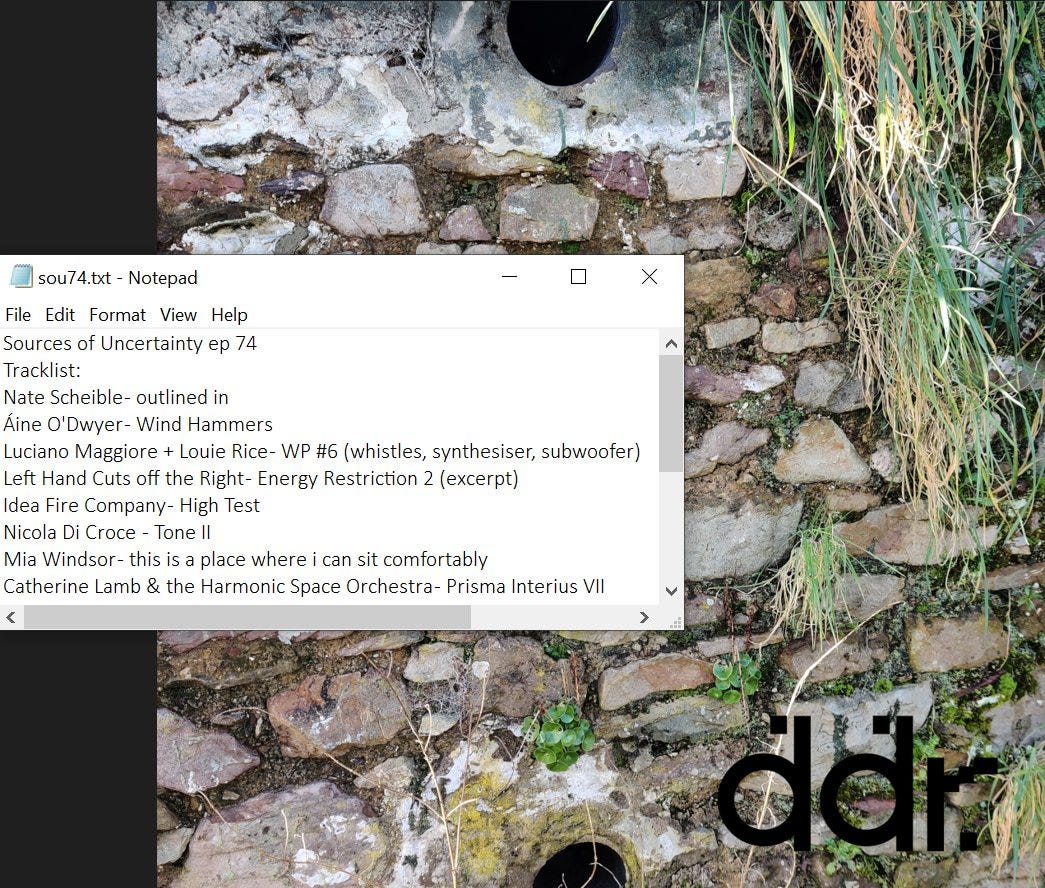
https://www.mixcloud.com/DublinDigitalRadio/sources-of-uncertainty-ep-74-070324/
In the space of a week, I was seeing Nate Scheible’s name in a lot of places, with or valleys and getting praise from all over the place. There’s crackle, fast moving fragments of sound and a paciness that never feels exhausting, this is maybe based around granular sampling or some kind of cutting up of sound, I can’t put my finger on it. But it feels like an approach that could become tedious in the wrong hands, but here is refreshing.
Aine O’Dwyer’s triple cassette album Turning in Space slipped by me until just before I was making this show. It’s ‘signature’ O’Dwyer in that it feels like it could go anywhere. There’s lots of character of the places she’s recording in on the recordings, all adding to the feel of the album. Something about this reminds me vividly of O’Dwyer’s set at Colour out of Space a good few years ago, or maybe I’ll just take any excuse to remember that set.
Luciano Maggiore + Louie Rice released one of my favourite albums of last year, Three Things. They can probably be characterised by a commitment to process and theme. There’s a playfulness and levity that makes the aforementioned commitment feel well grounded, and, most importantly, it always sounds good. Whistle Posse is music for whistles, synth and subwoofer, it’s slow and methodical, and there’s a slight shifting in and out of phase that I find extremely satisfying.
I met Robbie of Left Hand Cuts off the Right while in London, and promptly went back to listen to his music when I was home. Releases from the last few years are lovely, there’s some nicely considered sound arranged, and some album length tracks are minimilaism done perfectly. I’d say Energy Restriction 2 is a perfect example of this. It’s easy to listen to and get sucked into, but never ambient, sounds balance and reflect and take up their own space. This album is still getting repeated listens.
Sometimes two tracks slot in next to each other perfectly and I think that’s the case with the track above and the next from Idea Fire Company. I’m always glad to see another release from them and Bathroom Electronics didn’t disappoint. As I said about Left Hand Cuts off the Right, every sound sits perfectly, tastefully minimal.
Nicola Di Croce’s Affective Room Tones is made up of recordings from Xavier Veilhan’s Studio Venezia. It’s a nice reminder of the value of specific spaces for their effect on the sounds put into them, accidentally tying in with what I said about Aine O’Dwyer earlier.
More music from people I met while in the UK with a track from Mia Windsor. The album this is a place where i can sit comfortably is three pipe organ recordings from different locations. There’s a lot of pipe organ music on the go lately, but I really like this one. Nicely moving around and not leaning too heavily on any one tone from the organs. I first listened to this on the train from Leeds to Glasgow and it might always remind me of that journey now, which is nice.
This show finishes with another track that I enjoyed on that train journey, which also ties in an accidental minimalist theme with Catherine Lamb & The Harmonic Space Orchestra. More subtle shifting out of phase and plenty of deep listening, again, Prisma Interius VII & VIII is perfect on a train as anywhere else.
Sources of Uncertainty episode 75
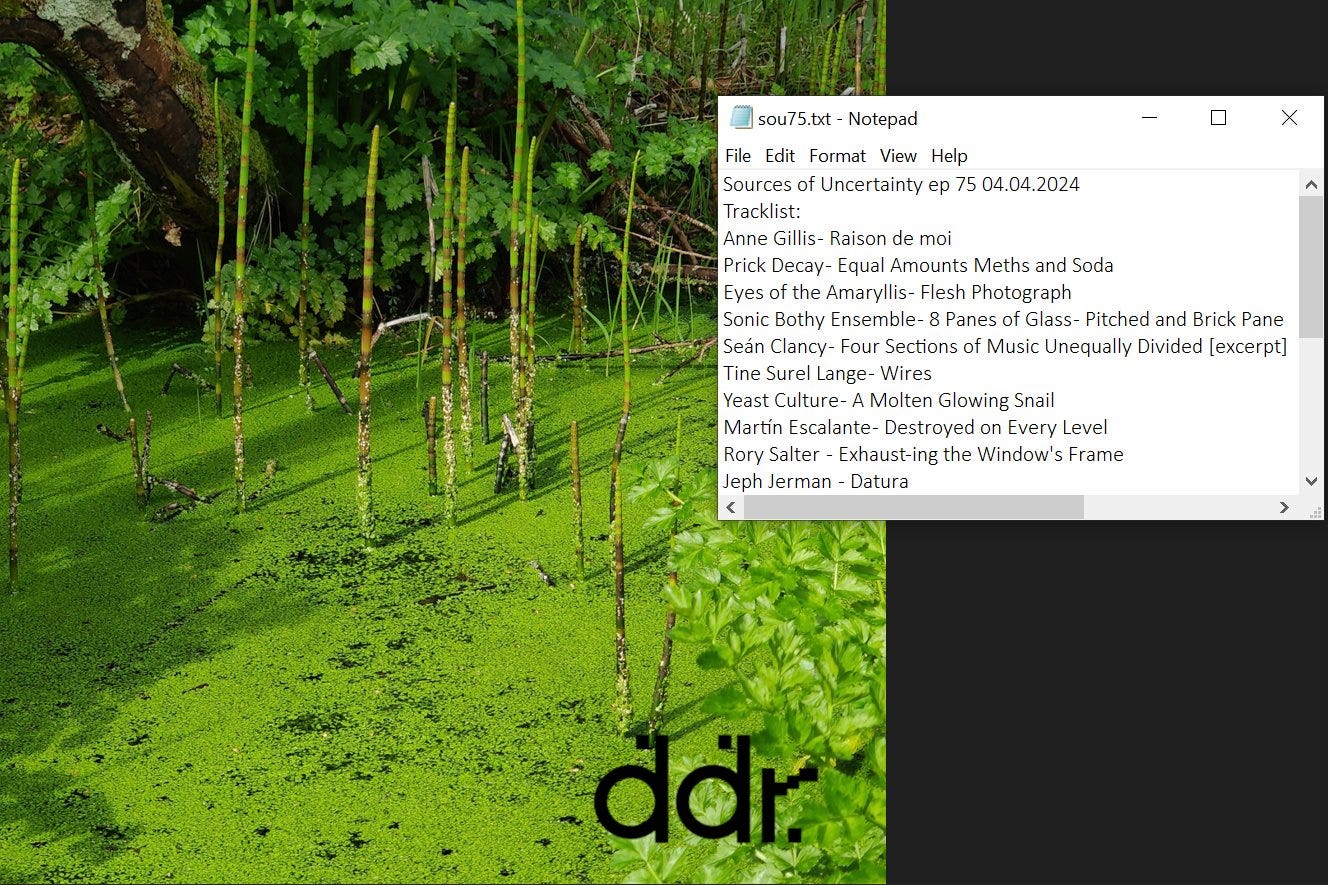
https://www.mixcloud.com/DublinDigitalRadio/sources-of-uncertainty-ep-75-04042024/
I often make these shows quite quickly, I try and put in what I’ve been listening to recently or what has been on my mind, I have four weeks to gather my thoughts and some music and I know what kind of thing I want to make. This latest show accidentally made a nice arc, starting with some gritty and slightly harsh sound, drifting into calmer stuff with a bit of indeterminacy, and coming back to harsher sound with some shorter, in the moment feeling stuff. None of that was very intentional but I suppose it’s natural that a month of my listening will feel coherent to me.
This one starts with Anne Gillis, which, along with two other tracks on this show, I got from the compilation Et si c'était le Vent qui avait Raison ? This is a pretty lo-fi recording, based around breath and slowly moving into hard to listen to territory, but never settling anywhere for too long.
I’d spent a weekend somewhere listening to this Prick Decay album Guidelines for Basement Non-Fidel and this track stood out to me (not just because it’s the second track on the album). Nice scratchy strings and gradually building electronics, grit aplenty.
Much like Mosquitoes, mentioned above, Eyes of the Amaryllis’ name seemed to be everywhere all of a sudden, and they also do some pulled apart rock music, Perceptible to Everyone is enjoyably loose and murky. This kind of thing can feel gratuitous to me at times, but this album never feels that way, sits nicely, confidently doing it’s own wonky sounding thing.
Sonic Bothy Ensemble describe themselves as “an inclusive new music ensemble that explores, composes & performs experimental & contemporary music. We are a group of musicians with & without additional learning support needs, some of whom are musicians working in Glasgow’s new music scene. Working across genres to define new ideas. we create original music that we perform to audiences across Scotland.” Which sounds great to me. Fields definitely has lots of exploration, without ever meandering. There’s a focus and brilliant meshing of sounds across the album. Still getting repeated listens here.
I’ve enthused about Seán Clancy’s music extensively in the past, and I’ve even interviewed him previously, which you can read here. One thing I mention in that interview is how much I like his often simple, descriptive titles. He’s at that again with Four Sections of Music Unequally Divided. A brilliant album, one single, almost three quarters of an hour long, piece, moving through the titular four sections beautifully. There are soft percussive sounds, warm electronics, piano and more here, pulling you in and moving through this long form piece of music.
Tine Surrel Lange’s music, is often based around installations, one off performances or accompanying video, and that visual sensibility is apparent in Works for Listening 1-10. On Wires, there’s a satisfyingly toned oscillating sound, maybe machinery, maybe not. The sound resonates and echoes, and slowly deeper sounds build up, a brilliant track from a brilliant album.
I paid particular attention to the Yeast Culture track on the Et si c'était le Vent qui avait Raison ? compilation for both the artist and track title. A Molten Glowing Snail does a good track name justice, it’s murky and weird, with some intermittent melody disrupted by noise. Sometimes it’s worth judging a track by it’s title.
The slight arc to the show reaches it’s noisiest point with Martin Escalante’s Destroyed on Every Level. Extremely intense and exhausting sounding saxophone playing. What initially feels violent can also be seen as a level of physical intensity you rarely hear elsewhere.
Whatever about any potential listener, my own nerves couldn’t take prolonged Escalante-level intensity, so Rory Salter breaks this up perfectly. On the Floor, by the Door does a classic move of including musical and incidental sound to make an album that feels close and almost intimate. There’s a lo-fi sound that sometimes pushes more musical elements out of focus, subtle, oddly homely and all round great.
This show finishes with the great Jeph Jarman, from the Et si c'était le Vent qui avait Raison ? compilation. His classic method of unidentifiable sounds and more-tracable electronics here. Can never get enough, which is just as well given how prolific he his.
And that’s me back up to date. Thanks for reading, and hopefully listening.
Full archive of radio shows here: https://listen.dublindigitalradio.com/resident/sources-of-uncertainty